
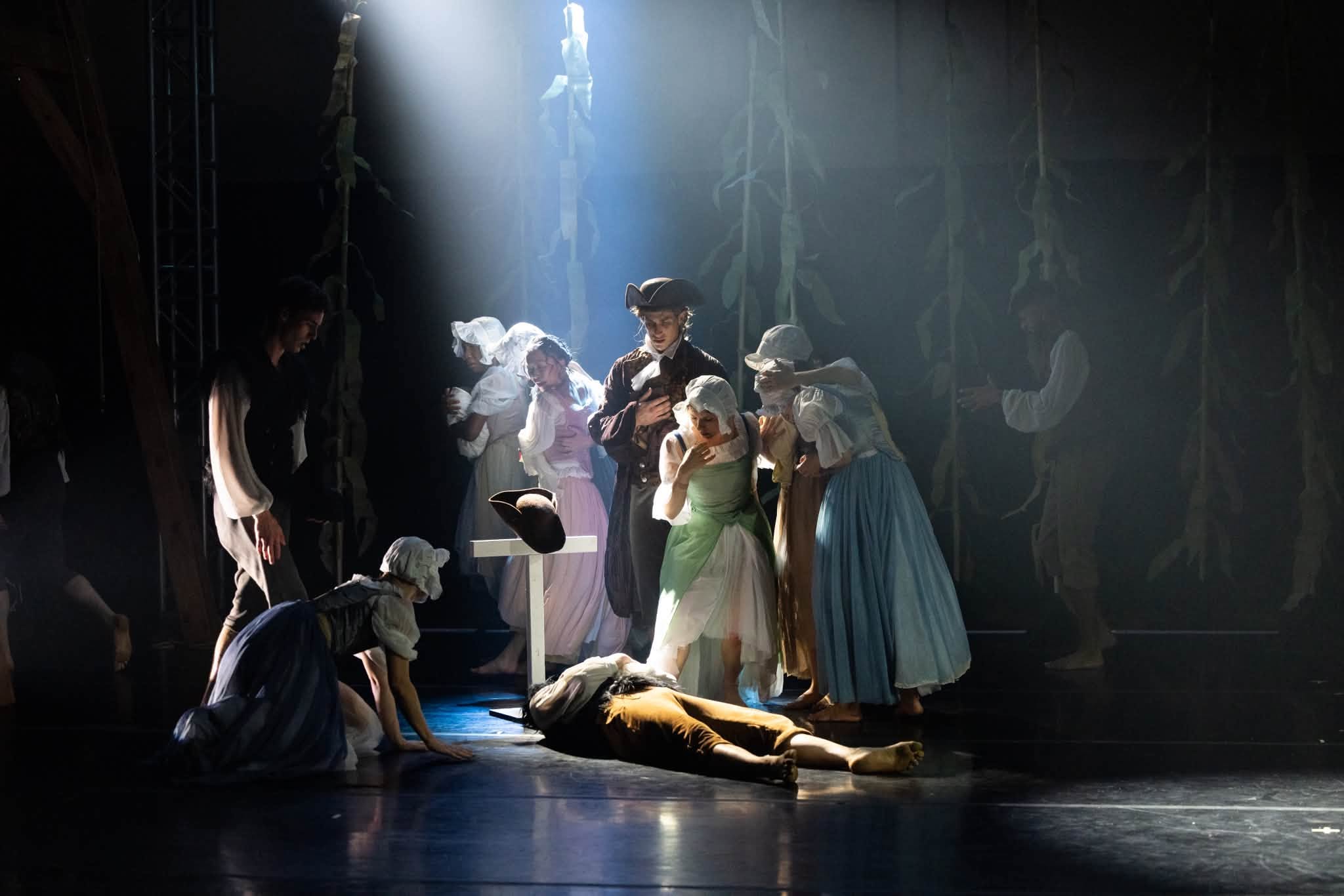
The Legend of Sleepy Hollow – Courtesy of Sonja Clark – Moonbug Photography. Used with permission.
Dance Kaleidoscope launched its 55th season Friday with an epic burst of theatrical dance at McGowan Hall on Indianapolis’ near Northside. The world premiere of Joshua Peugh’s The Legend of Sleepy Hollow unfolded with sweeping scale, haunting atmosphere and bold visual imagination, making the production a major event in Indiana’s performing arts. DK artistic director Joshua Blake Carter and executive director Kim Gutfreund brought that ambitious vision to life through an accomplished design team and a company of dancers whose exceptional talent, technical command and artistry gave the spectacle its pulse and power.
The Legend of Sleepy Hollow – Courtesy of Sonja Clark – Moonbug Photography. Used with permission.
Irving’s tale came ready-made for Halloween: an outsider unnerved by a secretive village, a courtship sharpened by rivalry, moonless roads and a horseman whose missing head had haunted the American imagination for more than two centuries.


Dance Kaleidoscope took that familiar tale and told it without spoken words, relying instead on movement, music, lighting and theatrical invention to create a world in which the line between reality and nightmare gradually disappeared.
The dancers did, however, emit cries, breaths and other nonverbal sounds. That unusual vocal layer reflected the story’s full emotional range, from joy and delight to fear and exertion, without breaking the work’s wordless spell.
The story centered on Ichabod Crane, an awkward, ambitious schoolmaster who arrived in Sleepy Hollow and became enamored of Katrina Van Tassel, placing him in competition with the imposing Brom Bones. Already fascinated and frightened by local ghost stories, Ichabod became especially vulnerable to the legend of a headless Hessian soldier said to haunt the countryside on horseback.
The Legend of Sleepy Hollow – Courtesy of Sonja Clark – Moonbug Photography. Used with permission.
After an evening at the Van Tassel home, Ichabod rode alone through the darkness. His imagination — and perhaps something more tangible — overtook him. He encountered the Headless Horseman and disappeared, leaving behind one of American literature’s most enduring mysteries.
Peugh showed a gift for making a familiar story feel as if it were being invented in front of us. The theatrical instincts evident in his earlier takes on Macbeth, Romeo and Juliet, The Tempest and My Dear Watson were at full strength, but Sleepy Hollow never felt like a repeat of past work. A boisterous barn dance told us who the villagers were before anyone needed an explanation. Ichabod’s sharp, skittering steps revealed a man whose nerves were already betraying him, and the final chase gathered bodies, splintered light and the looming horse puppet into a nightmare that seemed to spring from his mind. Peugh knew exactly when to let the humor breathe and when to pull the floor out from under it. By the time the shadows took over, every dancer, note of music and flash of light carried the story forward.
The creative team built the production’s menace layer by layer. Joshua L. Peugh’s choreography and direction worked in concert with William Boles’ scenery, Elizabeth Bourgeois’ costumes, Brandon Carson’s original music, Laura E. Glover’s lighting and the enormous horse puppet created by Monkey Boy Productions, with Nicholas Peugh serving as puppetry coach. Sapphire Theatre Company handled the scenic construction, while Stage Tech, Inc. supplied the lighting equipment and trusses. Boles and Bourgeois created a physical world rooted in folklore yet vulnerable to nightmare, while the looming puppet made the supernatural threat startlingly tangible. Carson’s score did more than accompany the dancers; it gave the story its pulse. The music lent buoyancy to the village scenes, caught the nervous rhythm of Ichabod’s imagination and steadily tightened during the final chase until movement and sound seemed driven by the same accelerating fear. Its shifts from rustic warmth to mounting dread helped the production turn almost imperceptibly from folk tale to nightmare. The scale, craftsmanship and seamless integration of those elements suggested a substantial investment, with the resources visible where they mattered most: onstage. Glover’s lighting proved especially potent: darkness did not merely surround the action but seemed to stalk it. Silhouettes, shadows and narrow pools of light withheld just enough for the audience’s imagination to complete the nightmare.
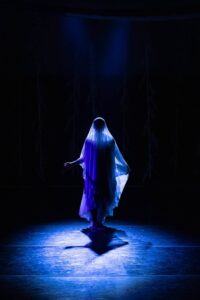 McGowan Hall did not merely house the production; it seemed to belong to it. The work was staged in an arena configuration, with an audience of 175 seated at cabaret tables and on risers surrounding the performance space. Traces of the building’s past as a 1922 Knights of Columbus Hall gave the ghost story an architectural memory of its own. Its age, character, and shadowed corners made the possibility of unseen inhabitants feel less fanciful than expected.
ZAY owned the stage as Ichabod Crane. His long-limbed, slightly off-kilter presence made Ichabod amusing at first, but the performance grew more unsettled as the schoolmaster’s imagination turned against him. A twitch, a sudden pause or a panicked rush across the stage revealed another crack in Ichabod’s composure. ZAY never pushed for effect; he let the fear build in the body until Ichabod seemed trapped inside his own superstition. Julie Russel gave Katrina Van Tassel a poised, magnetic presence, while Ryan Galloway’s Brom Bones carried the easy swagger of a man accustomed to getting his way. As the Headless Horseman, Gavin Kimmel cut a formidable figure, and the ensemble surrounded them with a restless energy that kept Sleepy Hollow feeling alive — and dangerously unpredictable.
What made The Legend of Sleepy Hollow so momentous was the rare completeness of its achievement. Peugh’s direction, the dancers’ dramatic commitment and the designers’ command of atmosphere operated as one theatrical force. In 50 years of reporting on performing art, including much of Dance Kaleidoscope’s work, I had rarely seen the company achieve this degree of unity, theatrical detail and technical execution. From that perspective, the production ranked among the company’s most accomplished works and compared favorably with dance theater I had seen at an international level.
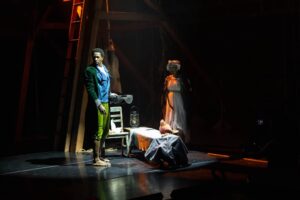
The Legend of Sleepy Hollow – Courtesy of Sonja Clark – Moonbug Photography. Used with permission.
Dance Kaleidoscope has expressed hope that Sleepy Hollow might become an annual Halloween tradition, and the production made that possibility feel not merely hopeful but inevitable. Rather than relying on a familiar seasonal staple, DK has created a haunting theatrical experience entirely its own.
The sold-out engagement secured its place in Dance Kaleidoscope history as more than a Halloween attraction. It announced the company’s artistic reach and gave those inside McGowan Hall the rare privilege of watching a new part of its identity take shape in real time. Those unable to attend lost the chance to witness a genuine company milestone; for those present, the evening carried the unmistakable charge of an experience unlikely to return in quite the same form.