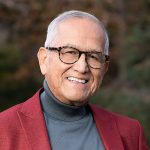
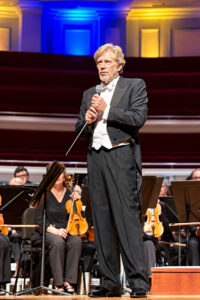
Maestro David Commanday – Courtesy of Debbie Bukler. Used with permission.
The Carmel Symphony Orchestra opened its 50th season Saturday at the Payne & Mencias Palladium with “HORIZONS: The Promise of a Vast Land.” The anniversary mattered, but the orchestra’s sound is what stayed with me.
Under conductor David Commanday, the strings had lift and warmth, the woodwinds spoke with individual character, and the brass produced weight without covering the rest of the ensemble. Soft passages retained their shape, and climaxes gathered momentum rather than simply piling on volume. If this concert is any indication, hiring Music Director Commanday was a coup. The orchestra is playing at a new level.
The program moved from the bold declaration of Copland’s “Fanfare for the Common Man” to the emotional depth of Dvořák’s Cello Concerto in B minor. Between them, Grofé’s “Grand Canyon Suite” painted a vivid American landscape, while Jerry Torr’s “Fanfare for a New Era” opened the second half with an upbeat flourish. Although the selections varied considerably in mood, each reflected the concert’s larger sense of space, movement and possibility.



Aaron Copland’s “Fanfare for the Common Man” established that standard immediately. The brass rang out with strength and brilliance, and the percussion strokes had tremendous impact. Yet Commanday resisted turning the piece into a contest of volume. He kept the sonorities spacious and the pulse deliberate, allowing the music to gather force on its own terms. The players watched him intently, and he appeared equally confident in them. That mutual trust made a familiar ceremonial work feel newly charged
Ferde Grofé’s “Grand Canyon Suite,” the orchestra turned scenery into sound. Broad, hushed passages suggested the canyon’s scale and stillness, while more animated sections bustled with color and motion. Commanday never exaggerated the contrasts. Instead, he gave the players room to bring the details forward. Guest concertmaster Zachary DePue was a standout. His solos were beautifully played, with a warm, clear sound that rose naturally above the orchestra. Whenever he played, he added a personal touch that made Grofé’s sweeping portrait of the Grand Canyon feel more immediate.
Jerry Torr’s “Fanfare for a New Era” opened the second half in a bright, celebratory mood. Engaging and well suited to the occasion, it made its point quickly, even if the effect was more immediate than lasting. More important, it reset the energy in the hall and prepared the audience for the concerto’s deeper emotional terrain.
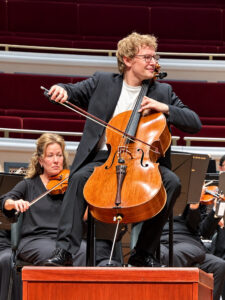
Alexander Hessler – Courtesy of Debbie Buckler. Used with permission.
Guest cellist Alexander Hersh was the evening’s other commanding presence. In Dvořák’s Cello Concerto in B minor, his impeccable technique never called attention to itself; it freed him to concentrate on the music’s emotional extremes. His bowing was assured, his phrasing clear, and his animated facial expressions showed how deeply he felt every change in mood. He did not keep that intensity to himself. He reached beyond the stage and made the audience part of the experience, especially in the concerto’s quieter passages. At times, the cello seemed to become his speaking voice. Commanday and the orchestra followed him closely, responding when the music became conversational and pulling back when Hersh needed room. Their rapport made the concerto feel spontaneous rather than rehearsed, and Hersh’s artistry held my attention throughout.
Before performing his encore, Giovanni Sollima’s “Lamentatio,” Hersh showed his engaging personality by describing the intrepid composer’s work as “Gregorian chant meets Metallica.” It was a fitting comparison. The piece begins like an ancient lament, with the cellist singing as he plays, then bursts into driving rhythms and rough, rocklike sounds. Hersh handled the sudden changes with ease. His voice and cello created an eerie atmosphere, while his energy and strong sense of rhythm gave the music its raw power. It was a perfect fit for a performer with the skill, intensity and charisma to bring it fully to life.
What impressed me most was not simply the orchestra’s polish, but its willingness to communicate. The strings could surge and recede without losing focus. The woodwinds brought personality to their lines. The brass supplied power without dominating, and the percussion heightened the drama instead of merely adding noise.
Commanday deserves much of the credit. He brought urgency and forward motion without pushing the music, and he made the sections sound as though they were listening to one another. That is what placed this performance on another level: technical control served expression at every turn.
For an orchestra beginning its 50th season, the concert did not feel like a backward glance. It sounded like the start of an exciting new chapter.