
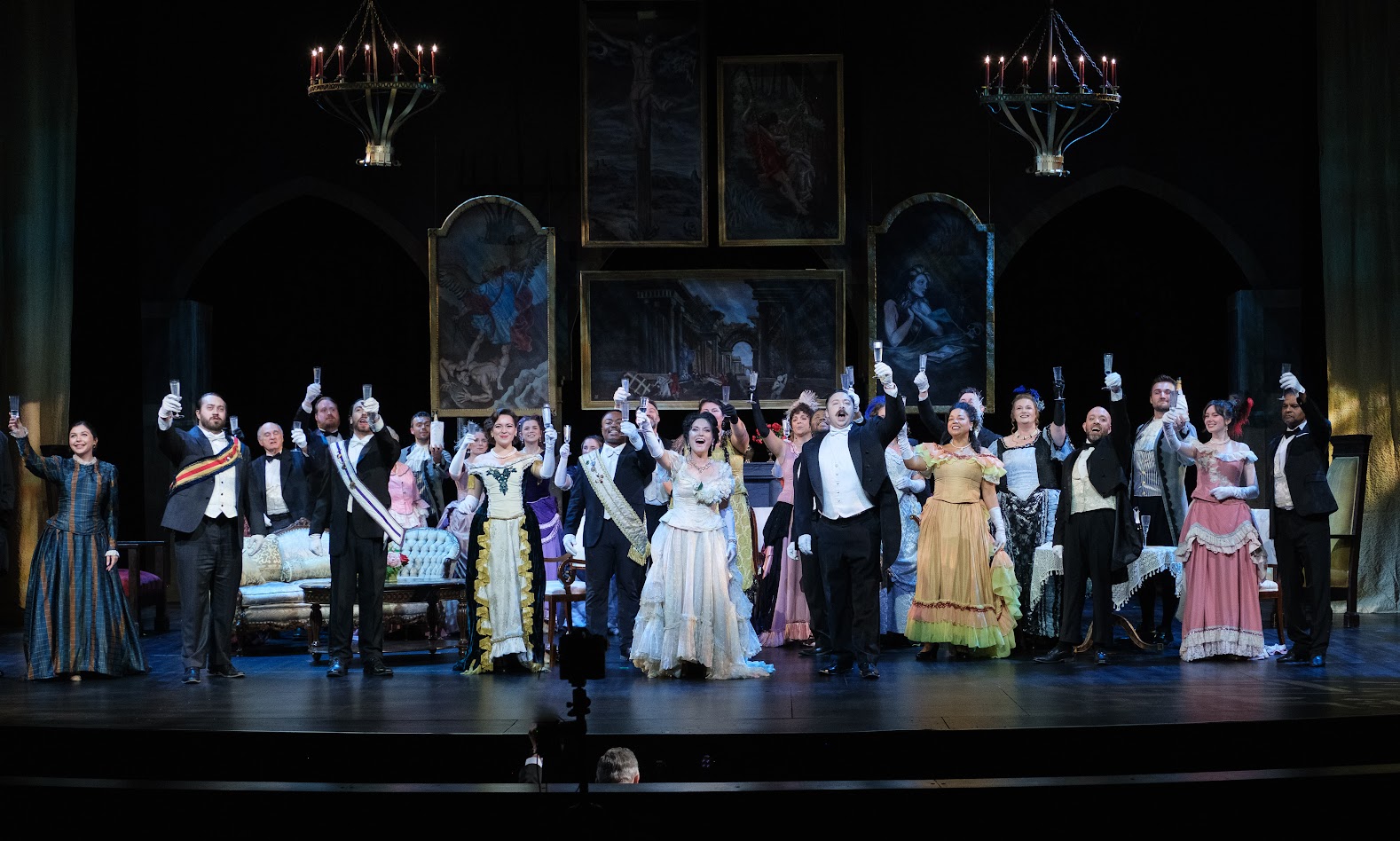
“La Traviata” – Courtesy of Indianapolis Opera. Used with permission.
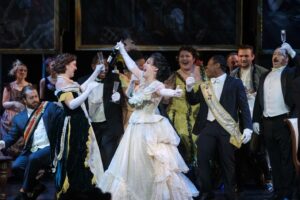
“La Traviata” – Courtesy of Indianapolis Opera. Used with permission.
Indianapolis Opera presented Giuseppe Verdi’s “La Traviata” at the Tarkington in Carmel, Indiana, on Saturday, Nov. 14, 2026, the second of the production’s three performances and part of the company’s 52nd season. With just over 500 seats, the hall is too intimate for distant spectacle yet ideal for an opera that depends on the audience believing in one woman’s love, her painful sacrifice and her solitary death. Ashley Fabian sang Violetta in her role debut, with tenor Evan K. Brown as Alfredo and Grammy Award-winning baritone Kenneth Overton as his father, Giorgio Germont.



From the opening party scene, the production’s interpretation was clear. Violetta is a modern woman managing her own life, finances and illness among guests who enjoy her company without truly seeing her. The emotional center was not the love duet but the Act II confrontation, where Overton played Germont not as a villain but as a father who believes he is doing his duty and only later grasps its cost. That made Violetta’s decision to leave Alfredo read as a genuine sacrifice rather than a plot device. In Act III, when the party music returned, distant and cruel, the final reunion and her death felt immediate. In a large house, the scene can feel remote. In Carmel, it did not.
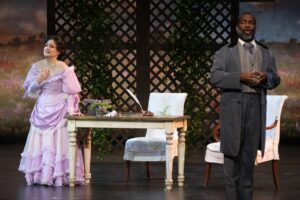
“La Traviata” – Courtesy of Indianapolis Opera. Used with permission.
Guest stage director Cynthia Lawrence deserves much of the credit for that clarity. Her direction was restrained and let the drama speak for itself. A noted soprano, Lawrence performed with Luciano Pavarotti more than 70 times and now holds the endowed voice and opera chair at the University of Kentucky. Her return to Indianapolis Opera, where she sang early in her career, was fitting. She kept the staging true to its period and focused on the characters.
The cast served that approach well. Fabian’s soprano was agile in the opening party, warm in Act II and hushed but unforced at the end, and she acted every phrase without losing Violetta’s dignity. The best-known numbers, from the Act I Brindisi to her “Sempre libera” and the Act III farewell, “Addio del passato,” were sung with care and conviction. Brown’s bright tenor made Alfredo’s devotion credible, and Overton sang with a rich tone and a convincing sense of remorse. The supporting ensemble, including Ashley Troester, Elizabeth Fisher, Antonio Domino, Erik Tofte and Ron Dukes, made distinct characters of small parts.
The chorus, prepared by chorus master Shederick Whipple, moved and sang with purpose, so the party guests read as a society rather than a crowd of extras. Whipple, a tenor who holds a doctorate from the Cleveland Institute of Music, knows the singer’s side of the stage, and the clarity of the ensemble work reflected careful preparation. The result was a polished, well-acted performance at a high professional standard.
Maestro Alfred Savia and the Indianapolis Opera orchestra served Verdi’s score well. Savia, the company’s artistic advisor and principal conductor, studied opera conducting in Milan and has led “La Traviata” in Indianapolis (2017) and in Tuscany (2013), and that familiarity showed. The orchestra supported the singers without covering them, gave the party-scene waltzes and the Brindisi lilt and made the Act III return of the party music sound thin and cruel, as Verdi intended.
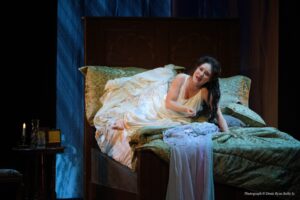
“La Traviata” – Courtesy of Indianapolis Opera. Used with permission.
The production values matched the quality of the singing. DJ Price’s sets evoked 19th-century Paris with economy and fit the Tarkington’s stage well. The hand-painted, impressionist backdrop of Violetta’s country estate was the most memorable element, its soft, luminous brushwork giving Act II a sense of light and air and making the lovers’ brief happiness look fragile.
Anyone who knows this story only through its popular adaptations will find it here in its original, richer form. This Violetta is more than a romantic heroine: she is a woman who chooses dignity over happiness and pays for that choice with her life. Indianapolis Opera made the audience feel the full weight of that choice.
The final performance of “La Traviata” is at 3 p.m. Sunday, Nov. 15, at the Tarkington in Carmel, Indiana.Tickets range from $42 to $102 and are available at thecenterpresents.org.