
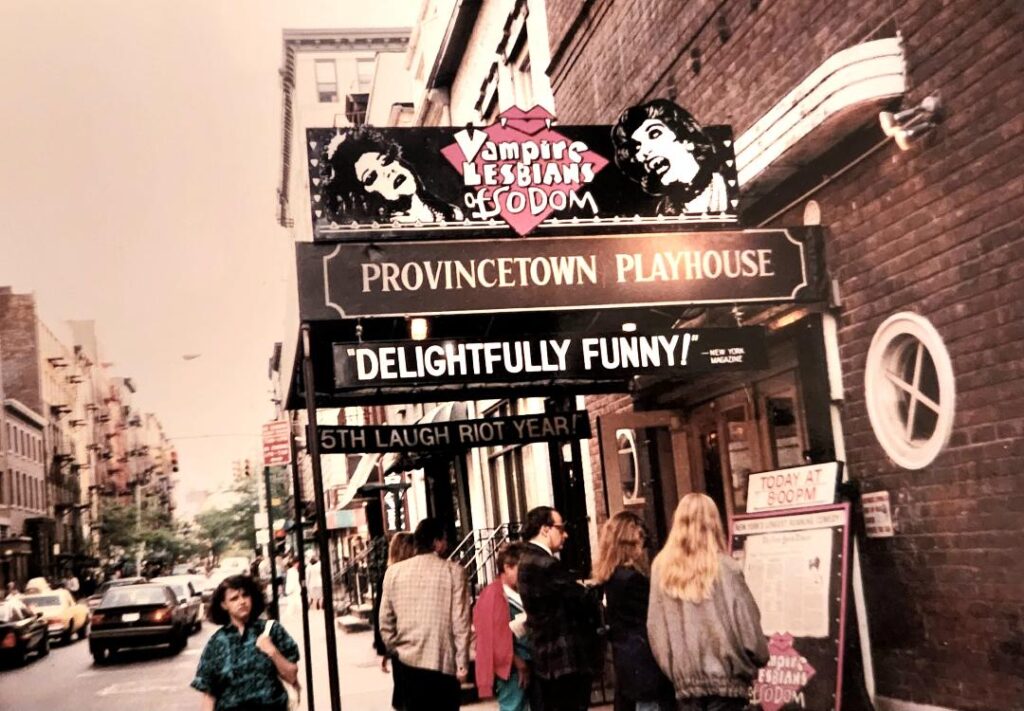
Provincetown Playhouse. Courtes of Charles Busch. Used with permission.
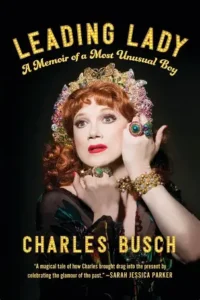 I recently conducted a Zoom interview with Charles Busch, who called from his Manhattan apartment, for my On the Aisle with Tom Alvarez podcast, available wherever you listen to podcasts. In our conversation, the playwright, performer, novelist and cabaret storyteller reflected on Aunt Lil, Charles Ludlam, camp, career longevity and the creative imagination that still keeps him at the desk. The following is a written summary of our chat.
Charles Busch has spent a lifetime making entrances: in wigs and gowns, in cabaret songs and Broadway scripts, in downtown theaters and on the page. At 71, the Tony-nominated playwright, performer and writer has already lived several theatrical lives—solo performer, drag trailblazer, Broadway playwright, screen actor, novelist, cabaret artist and memoirist, the latter role reflected in his memoir Leading Lady. But ask him what connects it all, and he reaches for the simplest word.
“The main line is really that I’m a storyteller,” Busch says. Even in cabaret, where he has performed more frequently in recent years, he treats songs less as vocal showcases than dramatic scenes. “I choose songs that I can really act,” he says. “I try to find the drama of them.”
A Life Built on Story

Charles Busch. Courtesy of Eric Stephen Jacobs. Used with permission.
That instinct has carried him from intimate rooms to the downtown theater scene, from the cult afterlife of Vampire Lesbians of Sodom to Broadway recognition for The Tale of the Allergist’s Wife, and eventually into the archives of the New York Public Library for the Performing Arts. The career has ranged widely, but the method has remained remarkably steady: invent the character, build the world, and invite the audience inside.
Long before Broadway, Busch was making his own opportunities. He spent years as a solo performer, playing entire worlds of characters in theatrical pieces that did not quite fit ordinary categories. One important early booking, he recalls, was at Indiana Repertory Theatre, a prestigious stop in the years before Vampire Lesbians of Sodom changed the scale of his career.



Aunt Lil and the Education of Charles Busch
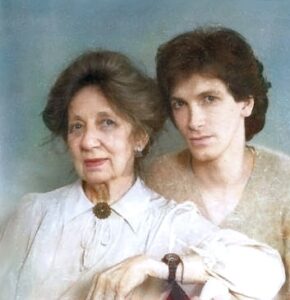
Charles Busch & Aunt Lil -Courtesy of Charles Busch. Used with permission,
To understand Busch’s imagination, it helps to begin with Aunt Lil. His mother died when he was seven, and after years of family losses, his mother’s older sister became the central adult in his life. He spent weekends with her as a child and later moved into her Murray Hill apartment full time when he was entering ninth grade.
Lil was a widow, a former nurse and teacher, and, in Busch’s telling, a woman of formidable insight. She gave him the bedroom in her small apartment and converted a dining alcove near the kitchen into her own sleeping space. When he turned 13, she marked the occasion not with a religious ceremony but with a symbolic gesture: a key to her apartment, a sign of trust and maturity.
“She was a woman of enormous insight,” Busch says. “What I was very fortunate was that she didn’t come into it with a fantasy of who she thought that child was going to be.” Instead, he says, Lil seemed to ask herself what raw material she had been given and how to help it flourish. “Now try to turn my cactus into a rose,” he says, laughing at the metaphor.
Lil encouraged independence, but she did not sentimentalize him. Busch describes her as loving, devoted and tough, determined that he become exactly who he was while also insisting that he remain honest with himself. She did not entirely understand the drag work that later became central to his public identity, but she supported the enterprise in practical ways, finding props and costume pieces at the charity thrift shop where she volunteered.
Her absence from one of his greatest public triumphs still stings. Busch’s mainstream Broadway success, The Tale of the Allergist’s Wife, starring Linda Lavin and Michele Lee, earned him a Tony nomination for Best Play. Lil died just before that moment. “That would have been something that she really could have gotten into,” he says. Even now, when he sees an award-show nominee bring a mother to the red carpet, he feels the loss.
Finding the Form
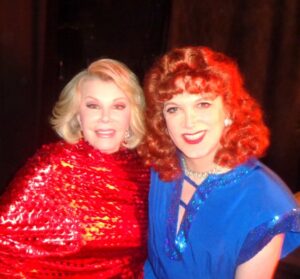
Joan Rivers & Charles Busch -Courtesy of Charles Busch.
Busch’s formal education did not offer a simple path. He attended the High School of Music and Art in New York as an art major, not a theater student, and later went to Northwestern University. At Northwestern, he says, he was not cast in department productions and became alienated from the theater program. But outside the official channels, something essential was happening.
His roommate Ed became an early audience of one. Busch would perform for him in their dorm room, evoking old movie actresses and trying on the voices and gestures that would later become part of his stage vocabulary. Ed recognized something in those private performances and told him, in effect, that this was what he ought to be doing.
The breakthrough came during senior year, when Busch wrote a play in the Ridiculous Theater mode about a traveling freak show and cast himself and Ed as Siamese twin sisters battling for independence and dominance. What began as a dorm-lounge plan moved into the student union auditorium when a midnight cult-film slot opened up. The audience’s response gave him a revelation. “The essential essence of who I am as a performer was fully born that night,” he says. “I just knew, okay, this is who I am.”
Lessons from Charles Ludlam
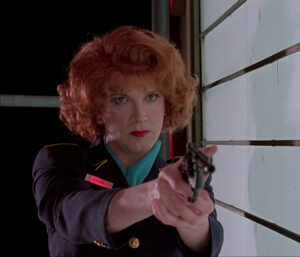
Charles Busch as Monica Stark. Courtesy of Charles Busch.
If Aunt Lil helped shape Busch’s sense of self, Charles Ludlam showed him what theatrical freedom could look like. Busch first saw Ludlam’s Ridiculous Theatrical Company as a teenager and remembers it as life-changing. Until then, he imagined theater as the Broadway musicals, dramas and comedies he had grown up seeing. Ludlam offered another possibility: a self-made theatrical universe drawing on classic film, opera plots, melodrama and fearless role-playing.
“There were no limitations to your imagination,” Busch says. Ludlam wrote roles for himself, performed them in his own small theater in the Village, and built an aesthetic in which actors played female characters not as a joke alone but because they were great at it. For Busch, the revelation was not simply drag; it was authorship.
There were comic lessons, too. As a young performer, Busch once stepped into Ludlam’s Bluebeard as Hecate, goddess of hell, after another actor needed to miss performances. Busch arrived with a glamorous costume and a carefully considered characterization. Ludlam kept telling him it needed to be bigger. Years later, Busch understood the note: his choice may have been interesting, but it did not serve the climax of Ludlam’s play. The lesson stayed with him. A bold performance still has to fit the world of the work.
Camp, Pathos and the Long Career
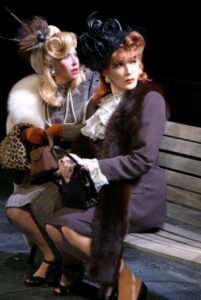
L-R Julie Halston & Charles Busch in The Lady in Question.”
Busch resists the idea that his work is merely broad camp. From the beginning, drag for him existed inside plays, inside characters and inside stories. “I never really saw drag for me as a point of satire,” he says. “I just really wanted to play these female roles on stage.” Comedy mattered, but so did feeling. “Pathos was as important as the comedy.”
That perspective allows him to admire younger artists without collapsing them into one lineage. He speaks warmly of Cole Escola, whose Oh, Mary! brought renewed attention to theatrical camp, and of Jinkx Monsoon’s success in mainstream musical theater roles. Camp, Busch notes, is not one thing. It is a broad spectrum, and each artist finds a different route through it.
Busch’s own path has included theater, movies, television, books and cabaret. He appeared on HBO’s Oz and on One Life to Live, where he played a female character without the usual plot twist of exposure. Mostly, though, he has followed projects that allow him to keep making his own material. His great ambition, he says, was never an Oscar, a sitcom or a particular prize. “My dream was to earn my living doing what I love,” he says. “And the fact that I’ve been able to do that for the past 50 years is a great triumph.”
The Imagination at the Desk
Longevity has not meant ease. Busch speaks candidly about failures, periods of dissatisfaction and the unsettling experience of going through decades of papers when the New York Public Library for the Performing Arts acquired his archive. At a moment when he expected to feel honored, he found himself rereading old work with brutal self-judgment. “I was the worst critic,” he says. Eventually, he emerged from that period and kept working.
His support system has included longtime collaborators and chosen family. He speaks with special affection of Kathy, who has done his wigs throughout his drag career and became, in his phrase, something like a “lavender wife.” They have known each other for more than 40 years, since before his career took off, and she remains one of the people who helps keep him grounded.
Still, Busch is clear about the central romance of his life. “My love really has been my creative imagination,” he says. “Not my career as much as just my creative imagination.” He spends long hours at the computer, moving among several projects, still writing roles for himself, still looking for the next story that can hold his attention.
Asked how he feels when people call him a legend, Busch accepts the word with characteristic humor. “I love it,” he says. “There are worse things to be called.” Still, the label matters less than the work. After half a century of writing himself into existence, he remains at the desk, moving between projects, listening for the next voice, the next scene, the next impossible entrance. For Charles Busch, storytelling is not a career he once chose. It is the place he keeps returning to, and the door he keeps opening.
Busch returns to 54 Below Sept. 11 & 12, 2026 with “Charles Busch Sings Johnny Mercer” at, 254 W 54th St, Cellar, New York, NY 10019. Tickets and details are at 54Below.org org (646) 476-3551.