
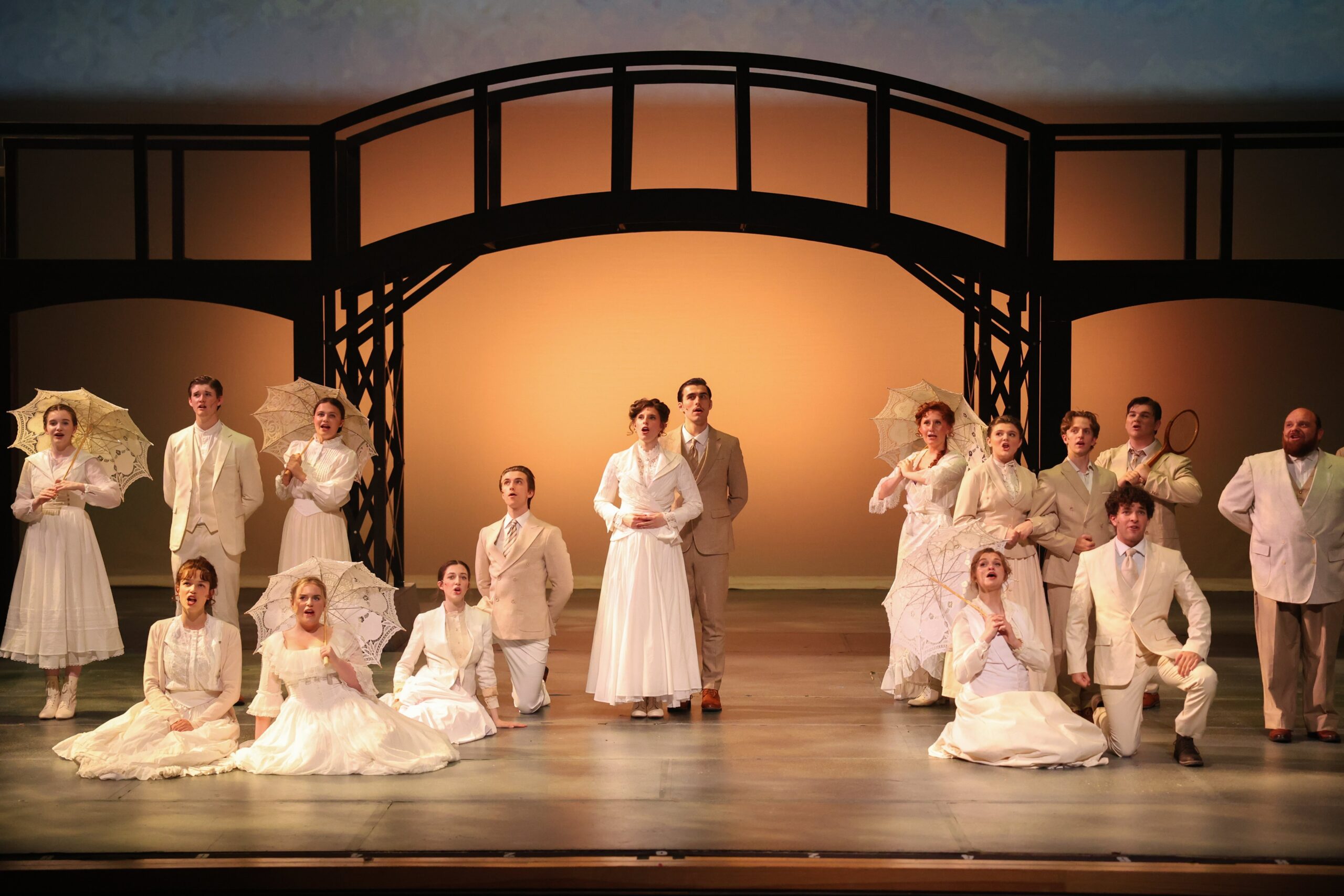
Ragtime – Courtesy of Addie McMillan. Used with permission
After seeing the 1998 Broadway production of Ragtime, I never would have guessed that more than 25 years later, I’d feel that same mix of hope, heartbreak and release again. But that’s exactly what happened while watching Summer Stock Stage’s preview of its revival, which opens Friday, June 26. at the Schrott Center for the Arts, on the campus of Butler University.
Ragtime – Courtesy of Addie McMillan. Used with permission
Ragtime has been around for decades, but it does not feel like a museum piece. Based on E.L. Doctorow’s 1975 novel, with music by Stephen Flaherty, lyrics by Lynn Ahrens and a book by Terrence McNally, the musical premiered in Toronto in 1996 before opening on Broadway in 1998. It became one of the major musicals of that season and won Tony Awards for its score and book. What matters most now, though, is how startlingly current it still feels. Set in the early 1900s, it looks back at a country wrestling with race, immigration, wealth, labor, justice and who gets to feel fully at home in America. More than a century later, those questions have not faded into the past; they are still part of our headlines, our politics and our daily lives. That is what gives Ragtime its urgency. The show reminds us that history is not safely behind us, but still pressing on the present, asking what kind of country we are willing to become.



The story follows three families whose lives gradually collide: a wealthy white family from New Rochelle, Coalhouse Walker Jr. and Sarah, and Tateh and his young daughter. Their paths cross in ways that are hopeful, painful and sometimes devastating, giving the show its sweep without losing the people at its center.
A huge part of why Ragtime lands so hard is the score. Stephen Flaherty’s music and Lynn Ahrens’ lyrics pull from ragtime, marches, gospel, waltzes and big Broadway anthems, but it never feels like a history lesson. Ragtime itself is more than a musical reference here; its syncopated rhythms help locate the story in the early 20th century, when America was changing fast, and they echo the show’s collisions between old and new, order and disruption, promise and unrest. The songs can sound grand and intimate at the same time, moving from bright energy to something quiet enough to catch you off guard. Under Teneh B.C. Karimu’s baton, the professional 33-member orchestra did not sit politely underneath the action; it surged, shimmered and breathed with the cast, turning every swell of brass, roll of percussion and hush of strings into part of the storytelling. In an era when most Broadway and touring productions use much smaller orchestras, hearing this many musicians play the score live felt almost luxurious. The sheer wall of sound gave the music weight and warmth, making the big moments feel truly enormous and the quieter passages even more delicate by contrast. By the time songs such as “Wheels of a Dream” and “Make Them Hear You” arrive, the music has built so much feeling that it is hard not to be moved by it.
Ragtime – Courtesy of Addie McMillan. Used with permission
The main characters include Mother, played by Allie Niethammer; Father, played by Justus Palumbo; Mother’s Younger Brother, played by Collin Alber; Grandfather played by Milo Ellis; Coalhouse Walker Jr., played by Michael Washington; Sarah, played by Cori Hughey; Tateh, played by Luke Aguilar; the Little Girl, played by Gracie Reckamp; and the Little Boy, played by Adam Palumbo. Historical figures also move through the edges of the story, including Booker T. Washington, Emma Goldman, Harry Houdini, Evelyn Nesbit, Henry Ford, J.P. Morgan and Stanford White.
Directed with clarity and heart by Emily Ristine Holloway, artistic director and co-founder of SSS, the 54-member cast, made up primarily of high school students, performed with a polish that felt far beyond student theater. The acting, singing and dancing reflected serious training, discipline and ensemble spirit. If anyone needs proof that the future of musical theater is alive and well, this production offers it. Several SSS alumni are currently appearing on Broadway and working in professional theatre across the country, and watching this cast, it is easy to understand why.
The leads also delivered vocally. Washington was a standout as Coalhouse Walker Jr., with a voice that had both power and ease. Hughey was equally affecting as Sarah, bringing a softer but just as moving quality to her songs. Together, they made “Wheels of a Dream” one of the night’s biggest moments. It really did stop the show. Their voices blended beautifully, but what made it work was how much feeling they brought to it without overdoing it. Another highlight was Niethammer as Mother, especially in “Back to Before.” She let the song grow naturally, and by the end, it felt like a turning point for the character, not just a big vocal number.
Ragtime – Courtesy of Addie McMillan. Used with permission
The choreography by Audra Bryant, Philip Crawshaw and Sean Aaron Carmon was another major reason the production had such momentum. With a cast this large, the movement could have easily become busy or cluttered. Instead, it felt sharp, clear and full of purpose. The big ensemble numbers had real drive, with bodies filling the stage in a way that made the show feel massive without ever looking messy. What stood out most was how the choreography helped tell the story, not just decorate it. It gave the opening number sweep, the dance sequences energy and the quieter moments shape. It was some of the most striking staging in the production and a big part of why the whole evening felt so professional.
The production values also did a lot of quiet heavy lifting. David Orr’s scenic design was spare and minimal, asking the audience to use its imagination rather than spelling out every location. That choice worked well for a show that moves through so many places and moments, and Rachelle Martin’s props helped fill in just enough detail to guide us without weighing the stage down. Caitlin Dailey’s period-perfect costumes immediately placed everyone in the right time and class, with hats, coats, dresses and uniforms doing as much storytelling as the dialogue. Kieran Shay’s lighting helped shift the mood from warmth to danger to memory, often before a word was spoken. Zach Rosing’s sound design kept the huge cast and orchestra clear without flattening the size of the music. Drew Bryson’s wig design helped complete the period look, giving the production that extra layer of detail that made the whole stage picture feel finished.
What makes this Ragtime so remarkable is that it never feels like a scaled-down or amateur version of a great musical. Educational theatre has its own important place, but this production operates on a different level, with the scale, discipline and finish of a professional staging. From the orchestra and vocals to the movement and design, Summer Stock Stage has built something with real size and feeling, and the result is a production that honors the musical while making it feel newly alive.
For tickets and info about “Ragtime,” which runs through June, 28, visit sumerstockstage.org