
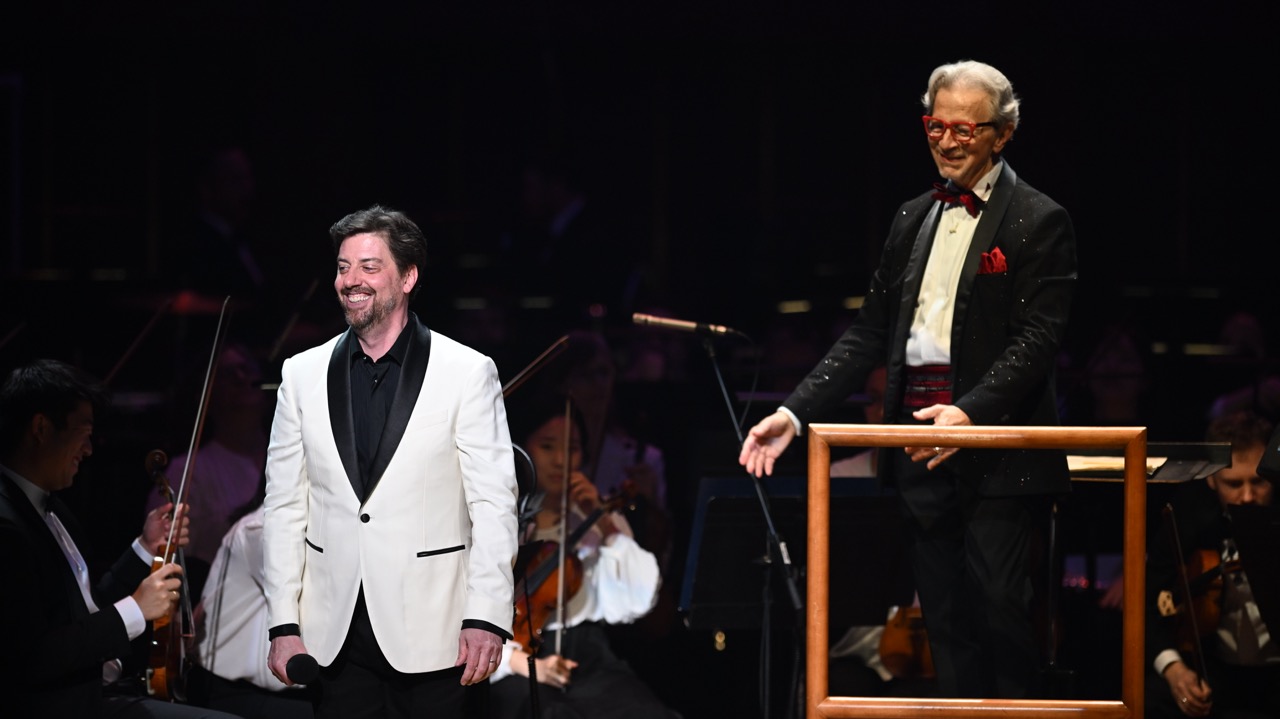
L-R Christian Borle and Jack Everly And The Winner Is – Coiurtesy of Tom Russo. Used with permission.
As someone who has worked as a filmmaker, theatre producer, actor, playwright, and lyricist over the course of my career, but who remains above all an avid fan of both art forms, I found And the Winner Is: Best Picture. Best Score. Best Song. especially resonant. Presented by the Indianapolis Symphony Orchestra as a Pops concert, conducted by Jack Everly and featuring special guest Broadway star Christian Borle, the program brought together two art forms that have long shaped my creative life. Much of the music felt like a portion of the soundtrack of my life, bound up with memories, aspirations, and the enduring influence of both film and theatre on my imagination. Hearing it performed live by a full symphony orchestra, and being so completely enveloped in it, was one of the concert’s greatest pleasures.


The Indianapolis Symphony Orchestra was, for me, the heart of the concert. There is something uniquely stirring about hearing music so closely tied to memory, story, and spectacle come alive in the hands of such a skilled ensemble. What also struck me was the vitality of the musicians, many of them strikingly young, bringing an energy that made the performance especially vivid. Under Jack Everly’s direction, the orchestra played with polish and confidence, but also with a generosity of spirit that made it inviting rather than merely impressive. Everly seemed able to coax the very best from them, channeling that youthful vitality into a dynamic force that gave these familiar scores new emotional immediacy. Their playing brought color and a genuine sense of occasion to the night.
And The Winner Is – Coiurtesy of Tom Russo. Used with permission.
Christian Borle brought to the program a charm, humor, and relaxed theatrical ease that I found immediately winning. His song choices leaned more toward wit and entertainment than deeper dramatic complexity, but that seemed entirely right for the buoyant spirit of the occasion. I was reminded throughout of what makes him such a distinctive Broadway performer: the vocal assurance, the comic timing, and the sense that he is always speaking directly to an audience rather than simply performing at it. I also especially enjoyed his banter with Jack Everly, whose dry sarcasm provided the perfect counterpoint to Borle’s lighter, more playful humor. Their exchanges gave the concert an engaging theatricality and made it feel warmly human rather than overly polished or routine.
What I appreciated most about the two-act program was the way it moved so fluidly between film music and Broadway favorites while maintaining a clear sense of shape and momentum. If I had one reservation, it was that Bridge Over Troubled Water, though beautifully performed, seemed somewhat outside the otherwise cohesive world of movie and Broadway music the program so effectively created. Even so, the concert offered a satisfying range of cinematic moods and associations, from Hooray for Hollywood, The Right Stuff, La La Land, and the MGM Overture in the first half to The Lord of the Rings, Beauty and the Beast, Hollywood Fanfares, and Star Wars in the second. Christian’s featured solos on Pure Imagination, You’ll Be Back, It’s Hard to Be the Bard, and Belle brought wit, warmth, and a strong theatrical presence. At the same time, cellist Austin Huntington moved me especially in Seven Years in Tibet and violinist Kevin Lin gave a deeply affecting performance in Schindler’s List.
I was also struck by the audience’s response: many seemed to be seniors, yet they responded with the alertness and discernment of listeners deeply attuned to this repertoire, and their appreciation added another layer of pleasure to the occasion. John Williams’s music was, for me, one of the program’s most powerful through-lines, and when Everly recalled the composer’s appearance with the ISO several years ago, his almost reverential tone underscored both Williams’s stature and the orchestra’s evident admiration.
In the end, what stayed with me most was not simply the excellence of the performances, though there was certainly plenty of that, but the personal sense of recognition and pleasure the concert gave me. This was music that has lived alongside my own experience of theatre and film for many years and has helped shape my imaginative life in lasting ways. Hearing it brought to life with such skill and heart was both moving and invigorating. More than a finely wrought presentation, it reminded me why these scores and songs continue to matter: they carry with them entire worlds of feeling, recollection, and imagination. It was a night that left me grateful not only for the artistry on display, but for the lifelong lifelong companionship of this music itself.