
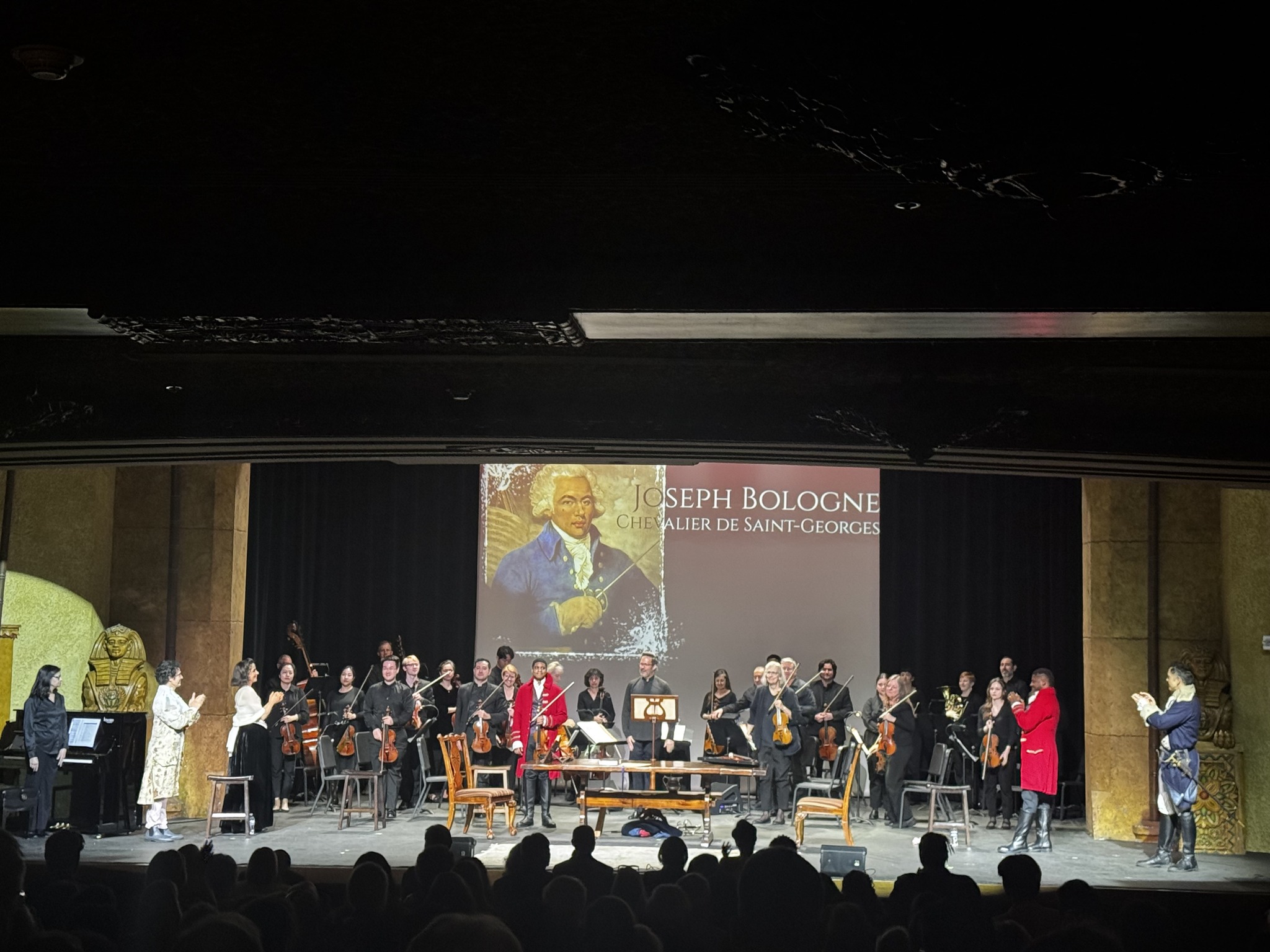
The Chevalier – Courtesy of ICO -Used with permission.
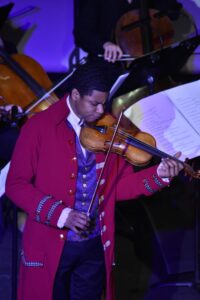
The Chevalier – Courtesy of ICO. – Used with permission.
How did someone as talented as Joseph Bologne, the Chevalier de Saint-Georges, end up nearly forgotten? In The Chevalier, Bill Barclay brought the composer and violin virtuoso to life onstage. Presented by the Indianapolis Chamber Orchestra under maestro Matthew Kraemer at the Madam Walker Theatre, the play honored this remarkable but long-overlooked 18th-century artist.



Bologne was a composer, violin virtuoso, fencer, soldier, and abolitionist, and the play made clear just how extraordinary he was. Just as important, though, the play showed how someone this talented could still be pushed to the margins of history because he was Black. What worked especially well was that Barclay did not turn him into a distant historical hero. In scene after scene, Bologne came across as talented, confident, and very human, while also dealing with the limits placed on him by race and class. That kept the play from feeling like a history lesson. Instead, it felt like a story about talent, injustice, and who gets remembered. It also made the play feel very current, since its ideas about racism, exclusion, and unequal recognition still connected to today’s political climate and to the realities many people continued to face. For me, that was what gave the play real weight: it was not only about one remarkable man, but also about why recovering Black history mattered in the first place.
The play also used its supporting characters well. Marie Antoinette, Amadeus Mozart, and Pierre Choderlos de Laclos were not just there as recognizable historical figures. Their scenes with Bologne helped show different sides of his life, but they also made clear how Black achievement could be admired and still not fully accepted. Marie Antoinette added warmth but also reminded us of the privilege and power surrounding him. Mozart brought humor and energy, while Laclos brought in the political tension of revolutionary France. Because of these characters, the play felt more layered and dramatic instead of simply admiring its main subject. It also made Bologne’s story feel part of a larger history about race, power, and whose contributions are preserved.
Another strength of the play was its structure. Barclay mixed dramatic scenes with Bologne’s music, so the audience got to hear his talent instead of just hearing about it. That made the play feel immediate and theatrical. The music was part of the argument the play was making: Bologne was a major artist whose work deserved attention. Even if the story moved quickly at times, the play did a good job balancing history, character, and performance in a way that was easy to follow and interesting to watch. The performances were another strength of the production.
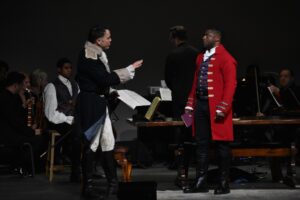
The Chevalier – Courtesy of ICO -Used with permission.
Under Matthew Kraemer’s baton, the Indianapolis Chamber Orchestra played Bologne’s music with energy and precision, and solo violinist Brendon Elliott, trained at the Curtis Institute of Music and Juilliard, gave a standout performance that captured both the beauty and brilliance of the score. The staging, directed deftly by Barclay, also made it clear that Joseph Bologne was represented in two ways: Elliott through the music and Merritt Johnson in the speaking role. The acting was equally strong, with Barclay as Pierre Choderlos de Laclos, David Joseph as Mozart, Merritt Janson as Marie Antoinette and Johnson giving a compelling performance in the speaking role as Bologne.
Another highlight was Charles Schoonmaker’s period costume design, which added elegant authenticity to the production.
Ultimately, The Chevalier was a smart and moving play that gave Joseph Bologne the attention he deserved. Bill Barclay made the play feel both historical and relevant, especially when it combined strong character scenes with live music. More than anything, the play left the audience thinking about how history is shaped and whose stories get left out. That idea felt even more meaningful because this production was staged at the historic Madam Walker Theatre, built in 1927 as part of the Walker Building and long known as a cultural, business, and community hub for Indianapolis’s Black community. The setting mattered even more because it was tied to A’Lelia Walker and Madam C. J. Walker, two seminal Black historical figures who both loved music and supported the arts. A’Lelia Walker was a major arts patron, and Madam C. J. Walker also supported Black musicians, actors, and artists. That made the theater more than just a venue—it became part of the meaning of the performance itself. It also reflected the Indianapolis Chamber Orchestra’s stated commitment to inclusion, diversity, equity, and access, since choosing this play and this venue showed how that commitment could shape programming in a real and visible way.